


STUDENT VOICE
"EnvironMentors helped me form a love for science"
- EnvironMentors Student
ABOUT THE PROGRAM
What is EnvironMentors?
EnvironMentors is a science education and college-access program with a mission to mentor and motivate high school students in the sciences as they plan and conduct environmental research and acquire skills that will allow them to build careers and contribute to real-world environmental solutions.
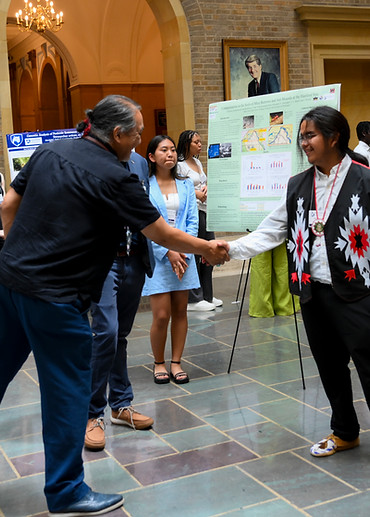
Students work alongside scientist mentors, conduct original research, and compete in an annual national research symposium — building confidence, skills, and pathways to college and careers in science.
Mentorship with working scientists
Students are paired with scientist mentors who guide their environmental research from design to presentation.
01
Hands-on environmental research
Students plan and conduct original environmental research, gaining real scientific skills and field experience.
02
College access & career pathways
The program helps students build the skills, networks, and confidence to pursue STEM careers and higher education.
03
National research symposium
Students compete annually at a national symposium, presenting their research to scientists and decision-makers.
04
HEAR FROM OUR STUDENTS
See EnvironMentors in action
Check out what our participants are saying about the EnvironMentors program — in their own words.
3000+
20+
Cities
OUR GLOBAL REACH
Our Chapters
EnvironMentors operates across North America, the Caribbean, Africa, and Latin America — hover to explore each region.

North America
12
Alabama · California · District of Columbia · Florida · Louisiana · New Jersey · New York · Ohio · Pennsylvania · Texas · Washington

Caribbean
2
Puerto Rico · Saint Lucia

Africa
1
Zambia

Latin America
2
Guayaquil - Ecuador
Bahia de Caraquez - Ecuador


GROW THE NETWORK
Start a Chapter
GCSE is always interested in working with organizations that would like to host a new EnvironMentors chapter. We will work with your institution to ensure you are prepared to launch a strong, long-lasting, and sustainable chapter.
Strong commitment to working with high school students in your community
Willing to meet program expectations in one-to-one mentoring, hands-on research, field experiences, and college preparation
Financial commitment to the local chapter’s operation
Desire to be part of an international network and community of learning

Check out what our students are working on
Assessing Feasibility of Nuclear Energy Aided Cement Production for Carbon Dioxide Emission Reduction
Xinran Li, Dr. Martin Nieto-Perez, Ondi Brown
Penn State, State College, PA, USA
This study explores the feasibility of inserting a microreactor as a heat source during cement production and its extent of reducing carbon dioxide emissions. Cement is a fundamental substance used in many construction projects. Emissions associated with cement production represent nearly 5% of U.S industrial sector greenhouse gas emissions and 1% of U.S total greenhouse gas emissions. CO2 is released through chemical reactions and the fuel used to heat reactions in cement production. According to data from the US Department of Energy in 2023, 65 million metric tons of CO2 were produced from using natural gas as fuel by 91 cement plants reporting data in the US. Nuclear reactors produce excess heat, which can heat cement plants in place of natural gas. Micro nuclear reactors function with the same fundamental technology as traditional nuclear reactors, but are smaller and less expensive than conventional reactors. Research institutions are investigating the extent to which microreactors can replace fossil fuels. The uses of nuclear energy, specifically microreactors, have not yet been explored in terms of reducing carbon dioxide emissions in industrial practices. To carry out this investigation, we used a Python Jupyter program to balance the masses and energies of the cement plant. We discovered that as much as 45% of CO2 produced by fuel combustion can be reduced if a microreactor is inserted into the calciner and the initial temperature of the solids is set at 350 degrees Celsius. If every cement plant in the United States switched to this model, a reduction of approximately 29.25 million metric tons of CO2 would be possible.
BECOME A SPONSOR
Interested in sponsoring EnvironMentors?
Contact us at: environmentors@gcseglobal.org